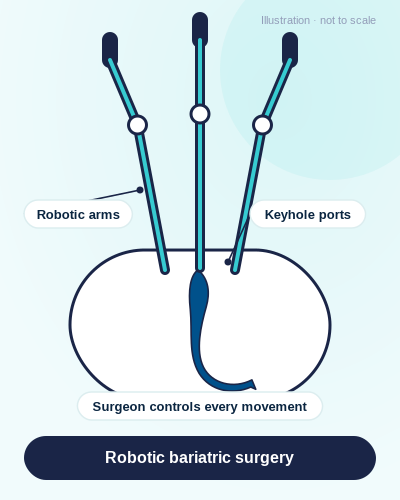
Robotic hernia surgery is keyhole surgery in which the surgeon controls fine robotic instruments from a console, with a magnified 3D view. Dr Amit Bhambri performs robotic repair of groin, umbilical, incisional and hiatal hernias at Fortis Hospital Ludhiana. The robot does not operate on its own: every movement is made by the surgeon.
How robotic hernia repair works
The operation is done through small cuts of about 8 mm, as in keyhole surgery. The surgeon sits at a console a few feet away and controls the camera and instruments. Compared with standard keyhole instruments, robotic instruments:
- bend like a human wrist, which makes stitching in tight spaces easier
- filter out tiny hand tremors, for steady movements
- give a magnified, three-dimensional view of the tissues
Which hernias can be repaired robotically?
| Hernia | Where robotic repair helps |
|---|---|
| Inguinal (groin) hernia | Large or repeat hernias, hernias on both sides, patients with previous lower tummy or prostate surgery |
| Umbilical and paraumbilical hernia | Larger hernias, hernias with divarication of the tummy muscles |
| Incisional and ventral hernia | Closing the gap with stitches and placing mesh within the muscle layers, which can be hard with standard keyhole tools |
| Hiatal hernia and reflux | Large and repeat hiatal hernias, where fine stitching deep under the diaphragm matters |
Possible benefits
- Small cuts and smaller scars, as with keyhole surgery
- Precise stitching, which helps in complex and repeat hernias
- Mesh can often be placed outside the abdominal cavity, between muscle layers
- Usually a short hospital stay and early walking
For many straightforward hernias, standard keyhole surgery gives an equally good result. Robotic surgery is chosen when it offers a real advantage for your hernia, not simply because it is available.
Robotic, keyhole or open: how is the choice made?
Dr Bhambri considers the type and size of hernia, previous operations, your weight and general health, and your preference. Because he performs open, laparoscopic and robotic repair, he can recommend the method that suits you and explain why. Robotic surgery may cost more than standard keyhole surgery, and insurance cover varies, so this is discussed openly.
Before and after robotic hernia surgery
- Before: examination, ultrasound or CT scan where needed, blood tests and an anaesthesia check. Stop smoking and control blood sugar.
- Hospital stay: often the same day or next day for groin and small hernias; one to three days for larger repairs.
- Recovery: walking the same day, desk work in about one to two weeks, heavy lifting after about four to six weeks, as advised.
Risks
The risks are similar to those of keyhole hernia repair: bleeding, infection, fluid collection, pain, injury to nearby organs and the hernia coming back. Occasionally the operation is changed to standard keyhole or open surgery for safety. Dr Bhambri explains the risks for your hernia before you decide.
Robotic surgery at Fortis Hospital Ludhiana
Fortis Hospital Ludhiana has a robotic surgery programme. Dr Bhambri also uses the robot for weight loss surgery and gallbladder surgery. To find out whether robotic repair suits your hernia, send your reports on WhatsApp or book a consultation.
Robotic hernia surgery FAQs
Does the robot do the operation by itself?
No. The surgeon controls every movement of the instruments from the console throughout the operation.
Is robotic hernia surgery better than laparoscopic?
For complex, large and repeat hernias it can make the repair easier and more precise. For many simple hernias, laparoscopic repair gives an equally good result.
Is robotic hernia surgery covered by insurance?
Many policies cover it, but some cover only part of the robotic charges. Check with your insurer; our team can help.
How long does robotic hernia surgery take?
Usually one to two hours for groin and small hernias, longer for large incisional or hiatal hernias.
Is a mesh used in robotic repair?
Most robotic repairs use a mesh to strengthen the repair. The type and position depend on the hernia.