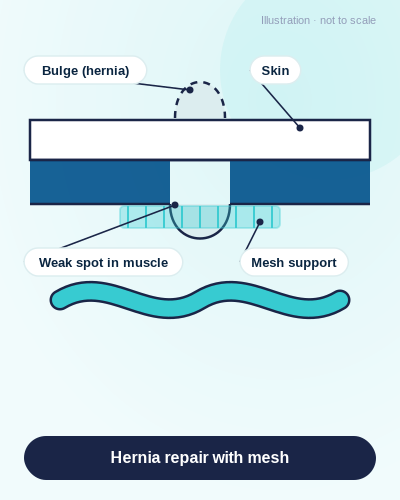
A hiatal hernia is when the top of the stomach slides up into the chest through an opening in the diaphragm, the muscle that separates the chest from the tummy. It is a common cause of acid reflux (GERD): heartburn, sour water in the mouth and burning in the chest. Dr Amit Bhambri performs keyhole (laparoscopic) and robotic hiatal hernia and anti-reflux surgery at Fortis Hospital Ludhiana.
Symptoms of hiatal hernia and acid reflux
- Burning in the chest (heartburn), especially after meals or at night
- Sour or bitter fluid coming up into the mouth
- Burping, bloating, or a feeling of food sticking
- Night-time cough, hoarse voice or throat clearing
- With large hernias: fullness after small meals, chest pressure or breathlessness after eating
Chest pain must always be checked for heart problems first. Go to emergency for chest pain with sweating or breathlessness, vomiting blood, or black stools.
Types of hiatal hernia
In a sliding hiatal hernia, the most common type, the join between the food pipe and stomach slides up into the chest. It often causes reflux. In a para-oesophageal hernia, part of the stomach rolls up beside the food pipe. These can become large and, rarely, twist, so repair is often advised even when symptoms are mild.
First treatment: lifestyle and medicines
Many people improve without surgery:
- Smaller meals, and dinner at least three hours before bed
- Raising the head end of the bed
- Cutting down on fried, spicy and very heavy meals, tea or coffee late in the day, and alcohol
- Stopping smoking and losing weight if needed
- Acid-reducing medicines prescribed by your doctor
When is surgery advised?
- Reflux continues despite medicines, or you do not want to take them for life
- Food or acid comes up into the throat (regurgitation) even with medicines
- A large or para-oesophageal hernia
- Complications such as inflammation or narrowing of the food pipe
Tests before surgery
Before deciding on surgery, Dr Bhambri arranges tests to confirm that reflux and the hernia are the cause of your symptoms and to plan the operation. These usually include an upper GI endoscopy (done by the gastroenterology team), sometimes a barium swallow, and for some patients a pH study and manometry, which measure acid reflux and the strength of the food pipe.
The operation: hiatal hernia repair and fundoplication
The surgery is done by keyhole or robotic surgery through five small cuts, under general anaesthesia:
- The stomach is gently brought back down into the abdomen.
- The widened opening in the diaphragm is tightened with stitches (sometimes reinforced).
- The top of the stomach is wrapped around the lower food pipe (fundoplication) to act as a valve and stop acid flowing back. A full wrap (Nissen) or a partial wrap (Toupet) is chosen based on your tests.
Robotic surgery can be especially helpful for large hiatal hernias and repeat operations, where fine stitching deep under the diaphragm matters.
Hiatal hernia with obesity
For people with obesity and reflux, a standard wrap works less well. A Roux-en-Y gastric bypass with hiatal hernia repair often treats both the weight and the reflux in one operation. If you already had a sleeve gastrectomy and now have reflux, revision surgery may be discussed.
Recovery and diet
- Hospital stay is usually one to two days.
- For the first few weeks you follow a soft diet, eating slowly and in small amounts, as swelling at the wrap can make swallowing tight.
- Avoid fizzy drinks, and bread or dry meat in the early weeks.
- Most people return to desk work in about two weeks.
Possible side effects and risks
Temporary difficulty swallowing is common in the first weeks. Some people notice more bloating and find it harder to burp. Other risks include bleeding, infection, injury to nearby organs, and the hernia or reflux coming back. Dr Bhambri explains which wrap and approach suits you to keep these as low as possible.
Cost of hiatal hernia surgery in Ludhiana
The cost depends on the size of the hernia, keyhole or robotic approach, any mesh used and the room category. It is shared in writing after your tests and consultation. Hiatal hernia surgery is usually covered by health insurance.
Hiatal hernia FAQs
Can a hiatal hernia go back by itself?
No. Lifestyle changes and medicines can control the symptoms, but the hernia itself does not go back permanently without surgery.
Will I be able to stop acid medicines after surgery?
Many people can stop or greatly reduce them, but some still need occasional medicine. Results vary from person to person.
Does Dr Bhambri do the endoscopy?
No. Endoscopy is done by the gastroenterology team. Dr Bhambri reviews the findings and plans the surgery.
Can I eat normally after a fundoplication?
Yes, after the first few weeks of soft food most people return to normal Indian meals, eating slowly and chewing well.
Is the surgery done by keyhole?
Yes, it is done by keyhole (laparoscopic) or robotic surgery through small cuts, not a large open cut.