
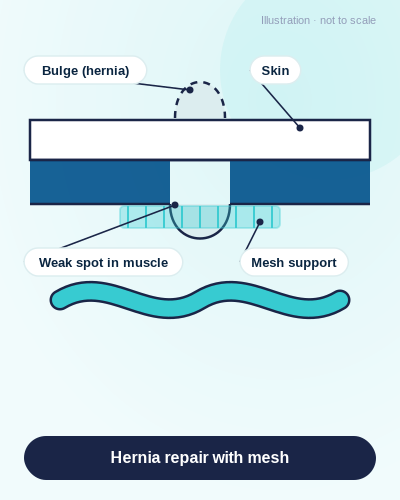
An umbilical hernia is a bulge at or just around the navel (belly button), where fat or bowel pushes through a weak spot in the tummy wall. In adults it is common after pregnancy and with excess weight. Dr Amit Bhambri repairs umbilical and paraumbilical hernias at Fortis Hospital Ludhiana with keyhole (laparoscopic), robotic or small open surgery, depending on the size of the hernia.
Umbilical and paraumbilical hernia: what is the difference?
A true umbilical hernia comes through the navel itself. A paraumbilical hernia comes through the tummy wall just above or below the navel. Both are treated in a similar way, and together they are among the most common hernias in adults. A hernia higher up in the middle of the tummy, between the navel and the chest bone, is called an epigastric hernia.
Symptoms
- A soft swelling at or near the navel, bigger when you cough, strain or stand
- The navel looks pushed out or changes shape
- Aching or pulling, especially after meals, lifting or a long day
- Skin over a large hernia may become thin or discoloured
Go to emergency straight away if the swelling becomes hard, very painful, red or cannot be pushed back, or if you have vomiting and cannot pass gas. A trapped hernia needs urgent surgery.
Who gets an umbilical hernia?
- Women after pregnancy, especially after more than one pregnancy or twins
- People with excess weight around the tummy
- People with long-standing cough, constipation or heavy lifting
- People with fluid in the abdomen from liver disease (needs special care)
In babies, many navel hernias close on their own in the first few years. In adults they do not close, and usually get slowly bigger.
Hernia or “divarication”?
After pregnancy many women notice a ridge or bulge down the middle of the tummy. This is often a divarication (diastasis) of the recti, a widening between the two long tummy muscles, rather than a hernia. It may happen together with an umbilical hernia. Dr Bhambri examines you, and an ultrasound helps to tell them apart, because the treatment is different.
When should it be repaired?
Adult umbilical hernias do not heal by themselves. A small, painless hernia can sometimes be watched. Repair is usually advised when the hernia is painful, getting bigger, or has a narrow neck (which raises the risk of trapping). If you are planning another pregnancy, Dr Bhambri may suggest timing the repair after it, unless the hernia causes problems.
Types of repair
| Method | Usually suited for | What happens |
|---|---|---|
| Small open repair | Small hernias (around 1–2 cm) | A small cut at the navel; the gap is closed with stitches, with or without a small mesh |
| Keyhole (laparoscopic) repair | Medium and larger hernias, several small hernias, or excess weight | Through small cuts away from the navel; the gap is closed and covered with a mesh from inside |
| Robotic repair | Larger hernias, hernias with divarication, repeat hernias | Keyhole surgery with robotic instruments for precise stitching; see robotic hernia surgery |
Mesh is used for most hernias larger than about 1 cm because it lowers the chance of the hernia coming back.
Recovery
- Most patients go home the same day or the next day.
- Walking starts the same day. Desk work is usually possible after about one to two weeks.
- Avoid heavy lifting and tummy exercises for about four to six weeks, or as advised.
- A soft abdominal binder may be advised for comfort for a few weeks.
Weight and umbilical hernia
Excess weight puts pressure on the repair and raises the chance of the hernia coming back. For patients with a high BMI, Dr Bhambri may suggest losing weight first, or, where suitable, combining hernia repair with weight loss surgery. You can check your BMI on our home page.
Risks
Risks include a fluid collection under the navel, infection, bruising, change in the look of the navel, ongoing pain in a few people, injury to the bowel (rare) and the hernia coming back. Smoking and diabetes raise the risk of wound problems, so stopping smoking and good sugar control before surgery help.
Cost of umbilical hernia surgery in Ludhiana
The cost depends on the size of the hernia, the method, the mesh and the room category. It is shared in writing after your consultation, and hernia repair is usually covered by health insurance.
Umbilical hernia FAQs
Can an umbilical hernia go away without surgery in adults?
No. In adults the gap in the tummy wall does not close by itself. A binder may make you more comfortable but does not repair it.
Can I get pregnant after umbilical hernia repair?
Yes. Pregnancy after repair is possible. If you plan more children soon, discuss timing with Dr Bhambri, as pregnancy stretches the tummy wall.
Will there be a scar at my navel?
With keyhole repair, the small cuts are away from the navel. With open repair, the cut is usually hidden in the curve of the navel.
Is it the same as divarication of recti?
No. Divarication is a widening between the tummy muscles without a hole. It can occur together with a hernia. Your surgeon will check which one you have.
How long does the operation take?
Usually about 30 minutes to an hour for a small or medium hernia, longer for large ones.