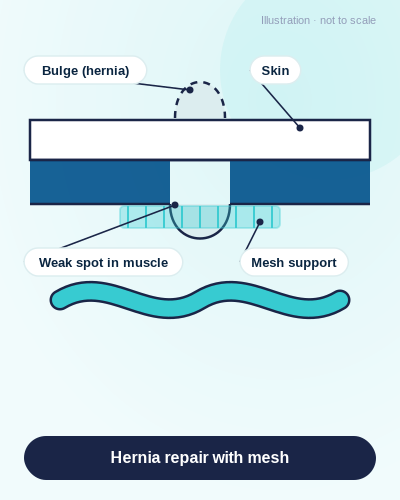
A hernia is a bulge where an organ or fatty tissue pushes through a weak spot in the muscle wall. Dr Amit Bhambri treats hernias in Ludhiana at Fortis Hospital using keyhole (laparoscopic) and robotic surgery, including inguinal, umbilical and incisional hernias, and hiatal hernias that cause acid reflux (GERD).
Types of hernia treated
Inguinal hernia
A bulge in the groin, more common in men. It may hurt when lifting, coughing or standing for long.
Umbilical and ventral hernia
A bulge at or near the navel or elsewhere on the front of the abdomen. More common with excess weight and after pregnancy.
Incisional hernia
A bulge through the scar of an earlier operation, such as a caesarean section or open surgery.
Hiatal hernia
Part of the stomach slides up into the chest through the diaphragm, often causing heartburn and reflux.
Symptoms that need attention
- A lump that comes and goes, especially when standing or coughing
- Pain, heaviness or dragging in the groin or abdomen
- Heartburn, sour taste, regurgitation or chest discomfort (hiatal hernia)
Go to emergency straight away if a hernia becomes very painful, hard and cannot be pushed back, or if you have vomiting and cannot pass gas. This can mean the hernia is trapped and needs urgent surgery.
Do all hernias need surgery?
Hernias do not heal on their own and usually get bigger over time. Surgery is the only lasting treatment. Small hernias without symptoms are sometimes watched, but most are repaired to prevent the risk of becoming trapped. For hiatal hernias, medicines are tried first, and surgery is considered when symptoms continue or the hernia is large.
Laparoscopic hernia repair
In keyhole hernia repair, the surgeon works through small cuts, returns the bulging tissue to its place and reinforces the weak area, usually with a medical mesh. Compared with open surgery, keyhole repair usually means less pain, smaller scars and a quicker return to normal activity. Both sides can be repaired in one operation if needed.
Hiatal hernia and GERD surgery
For a hiatal hernia, the stomach is brought back into the abdomen, the opening in the diaphragm is tightened with stitches, and a “wrap” (fundoplication) may be made to stop acid flowing back. In people with obesity, a gastric bypass with hernia repair is often the better option for reflux, as it treats both problems. Robotic surgery can help with large hiatal hernias.
Recovery after hernia surgery
- Most patients go home the same day or the next day after groin hernia repair.
- Walking starts the same day; light work is often possible within a week or two.
- Avoid heavy lifting for about four to six weeks, or as advised.
- After hiatal hernia surgery, a soft diet is followed for a few weeks.
Risks
Possible risks include bleeding, infection, pain, fluid collection, injury to nearby structures and the hernia coming back. After hiatal hernia repair, some people have temporary difficulty swallowing. Dr Bhambri explains the risks for your type of hernia.
Hernia and weight
Excess weight raises the chance of a hernia coming back. For patients with obesity, Dr Bhambri may discuss losing weight first, or combining hernia repair with bariatric surgery where suitable.
Cost of hernia surgery in Ludhiana
The cost depends on the type and size of hernia, the mesh used and the room category. It is shared in writing after the consultation, and hernia surgery is commonly covered by health insurance.
Hernia surgery FAQs
Can a hernia go away without surgery?
No. A hernia does not heal by itself. A belt or truss may hold it in temporarily, but it does not repair the weak spot.
Is mesh safe?
Mesh repair is the standard method for most groin and abdominal hernias and lowers the chance of the hernia coming back. Dr Bhambri will explain the type of mesh used.
How long is the hospital stay?
For most groin hernias, the same day or one night. Larger or hiatal hernia repairs may need one to two days or more.
Can hiatal hernia cause chest pain?
It can cause burning chest discomfort, but chest pain must always be checked to rule out heart problems first.
When can I lift weights again?
Usually after about four to six weeks, building up gradually. Your surgeon will advise based on your repair.